Cypress MUD Taxes Explained
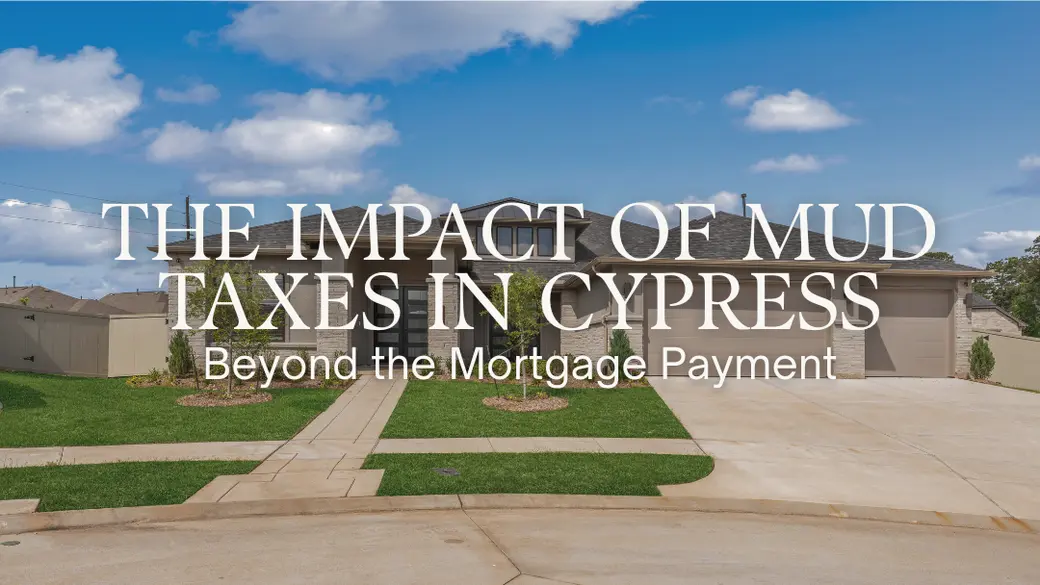
Cypress MUD Taxes Explained: What Home Buyers Need to Know Before Purchasing in Northwest Harris County
When buyers compare communities like Bridgeland, Fairfield, Coles Crossing, Towne Lake, and Dunham Pointe, the conversation usually centers around schools, amenities, builders, and home prices.
Less attention is given to the ongoing cost of ownership.
Property tax rates can vary significantly across Cypress, with MUD taxes often driving much of the difference. Newer communities generally carry higher rates to fund infrastructure, while established neighborhoods may see lower tax burdens as bond debt is paid down over time.
For many buyers, understanding these costs is just as important as comparing the homes themselves.
What Is a MUD Tax in Texas?
A Municipal Utility District (MUD) tax is an additional property tax that helps pay for infrastructure such as water, sewer, drainage, and roads within many Cypress communities. MUD taxes are separate from county and school taxes and can significantly impact a homeowner's total tax rate.
Rather than requiring a city to fund these projects upfront, the district issues bonds to build the infrastructure needed to support development. Homeowners within the district then help repay that debt through a portion of their property taxes over time.
Because every community is at a different stage of development, MUD tax rates can vary significantly across Cypress and Northwest Harris County. Those differences can have a meaningful impact on both your annual property taxes and your monthly mortgage payment.
How Much Are MUD Taxes in Cypress?
There is no single MUD tax rate across Cypress.
Rates vary depending on the age of the community, remaining bond debt, and future development plans.
Property taxes in Cypress can be higher than many buyers expect because homeowners may pay taxes to multiple entities, including school districts, counties, emergency service districts, and Municipal Utility Districts (MUDs). Newer master-planned communities often carry additional infrastructure debt that contributes to higher overall tax rates.| Average MUD Tax Rates by Community Age | ||
|---|---|---|
| Community Type | Typical MUD Tax Rate | What This Usually Means |
| Newer Master-Planned Communities | 0.80% – 1.20%+ | Higher infrastructure costs and newer bond debt |
| Growing Communities | 0.50% – 0.80% | Active development with ongoing infrastructure expansion |
| Established Communities | 0.25% – 0.50% | More residents sharing the tax burden and lower remaining debt |
| Mature Communities | 0.00% – 0.30% | Many original infrastructure bonds have been paid off |
Why Do Some Cypress Neighborhoods Have Higher Taxes?
The difference often comes down to community age.
When a master-planned community is first developed, significant infrastructure must be built before homes can be sold.
That includes:
- Water treatment facilities
- Sewer systems
- Retention ponds
- Drainage systems
- Utility lines
- Road improvements
Infrastructure improvements are typically funded through MUD bonds. As the community grows and more homeowners contribute to the tax base, the debt is spread across a larger population, often resulting in lower tax rates over time.
Comparing Cypress Communities
Not all Cypress neighborhoods carry the same tax burden. In many cases, the age of the community and remaining infrastructure debt play a significant role in determining overall tax rates.
Generally, newer master-planned communities have higher MUD taxes because infrastructure is still being built and bond debt remains relatively new. More established neighborhoods often benefit from lower MUD obligations as infrastructure costs have been spread across a larger tax base and debt has been paid down over time.
| Cypress Community Tax Comparison | ||
|---|---|---|
| Community | Typical MUD Environment | Typical Total Tax Rate |
| Bridgeland | Higher due to ongoing growth and infrastructure expansion | ~3.0% – 3.5% |
| Towne Lake | Moderate to higher depending on section | ~2.8% – 3.4% |
| Dunham Pointe | Higher due to newer development | ~3.0% – 3.5% |
| Cypress Creek Lakes | Moderate in most sections | ~2.4% – 2.8% |
| Coles Crossing | Lower due to community maturity | ~2.2% – 2.7% |
Bridgeland and Coles Crossing provide a useful example of how community age can influence property taxes. As one of Cypress' fastest-growing master-planned communities, Bridgeland continues expanding with new homes, amenities, schools, parks, and infrastructure. Those ongoing investments often contribute to higher MUD tax obligations in certain sections of the community.
Coles Crossing, by contrast, is a more established neighborhood where much of the original infrastructure was completed years ago. As a result, homeowners often benefit from lower MUD-related tax burdens while still enjoying mature trees, established amenities, and a well-developed community atmosphere.
For buyers comparing neighborhoods, the difference in tax rates can translate into hundreds of dollars per month in housing costs, making it an important factor to consider alongside home price, schools, amenities, and commute times.
How Much Can MUD Taxes Affect Your Mortgage Payment?
Many buyers focus solely on home price and interest rate.However, property taxes can have just as much impact on affordability.
| How MUD Taxes Can Impact Monthly Payments | ||
|---|---|---|
| Example | Higher Tax Community | Lower Tax Community |
| Home Value | $500,000 | $500,000 |
| Total Tax Rate | 3.40% | 2.40% |
| Annual Property Taxes | $17,000 | $12,000 |
| Monthly Tax Cost | $1,417 | $1,000 |
| Difference | Approximately $417 per month ($5,000 annually) | |
On a $500,000 home, a 1% difference in total property tax rate can increase ownership costs by roughly $5,000 per year, or about $417 per month. That's why comparing total ownership costs, not just purchase price, is so important when evaluating Cypress communities.
Do MUD Taxes Ever Go Away?
One of the biggest misconceptions is that MUD taxes remain high forever. In many cases, they do not.
As communities mature:
1. More homes are built
2. The tax base grows
3. Bond debt is gradually repaid
4. Debt service tax rates often decrease
This process can take many years, but it is common to see tax rates decline as developments age.
That said, every district is different. Some districts continue issuing new bonds to fund future expansion projects, while others may reach a point where debt obligations are substantially reduced.
MUD Taxes vs HOA Fees
MUD taxes and HOA fees are often discussed together, but they serve very different purposes.
A MUD tax helps fund public infrastructure such as water, sewer, drainage, and utility systems within a community. HOA fees, on the other hand, are used to maintain neighborhood amenities and common areas.
When evaluating the total cost of ownership, it's important to consider both. A community with lower property taxes may have higher HOA dues, while another may have higher taxes but lower annual HOA fees.
| MUD Taxes vs. HOA Fees | ||
|---|---|---|
| Category | MUD Tax | HOA Fee |
| Collected Through Property Taxes | Yes | No |
| Funds Water, Sewer & Drainage Infrastructure | Yes | No |
| Maintains Pools, Parks & Common Areas | Sometimes | Yes |
| Based on Home Value | Yes | No |
| Typically Fixed Annual Cost | No | Yes |
| May Change Over Time | Yes | Yes |
Questions Buyers Should Ask Before Purchasing
Before purchasing a home in Cypress, consider asking:
- What is the current total tax rate?
- How much of that rate is MUD tax?
- Has the MUD rate changed recently?
- Are additional bonds planned?
- What are the annual HOA fees?
- How do taxes compare with nearby communities?
These questions can help prevent surprises after closing.
The Bottom Line
MUD taxes are not inherently good or bad. They are simply part of how many Texas communities fund infrastructure and growth.
For buyers considering Cypress neighborhoods such as Bridgeland, Towne Lake, Dunham Pointe, Fairfield, Cypress Creek Lakes, or Coles Crossing, understanding the relationship between MUD taxes, HOA fees, and overall affordability is an important part of making a confident decision.
The right neighborhood is not always the one with the lowest tax rate. It is the one that best aligns with your budget, lifestyle, commute, schools, and long-term goals.
Thinking About Buying in Cypress?
One of the most common mistakes buyers make is focusing only on the purchase price while overlooking property taxes, MUD taxes, insurance costs, and HOA fees.
At Newcomb Realty Group, we help buyers compare communities, tax rates, HOA fees, insurance costs, and monthly payment scenarios before making an offer. Our goal is to help you understand the true cost of ownership so you can buy with confidence.
📲 Connect with us: Instagram | Facebook | TikTok | YouTube | LinkedIn
🌐 Visit our website: www.newcombrealtygroup.com
📞 Call for a consulation: 832-779-5478
Related Reading
Categories
- All Blogs (108)
- Conroe (4)
- Cypress (17)
- Dallas-Fort Worth (2)
- Hockley (5)
- Home Ownership Information (43)
- Home Purchase (1)
- Houston (9)
- Katy/Fulshear (10)
- Magnolia (4)
- Market Forecast (12)
- Memorial (2)
- Neighborhood Information (44)
- New Caney (2)
- Pearland (5)
- Real Estate (3)
- Relocation Guide (49)
- Retiree Relocation (4)
- Richmond (5)
- Spring (5)
- Sugarland (4)
- The Woodlands (6)
- Tomball (6)
- Waller (2)
Recent Posts








Realtor® Listing Specialist and Team Lead License ID: 634969
+1(832) 779-5478 | kristina.newcomb@exprealty.com