
Texas Homestead Exemption Guide | How to File

Texas Homestead Exemption Guide (2026): How to File, Deadlines, Savings & FAQs
Buying a home in Texas is exciting, but if you miss one key step after closing, you could pay more property taxes than you need to.
Filing your Texas homestead exemption can reduce your taxable value and, once in place, helps protect you from large year-over-year increases through the 10% homestead cap.
Below, we’re answering the most common questions Texas homeowners ask, outlining the step-by-step process, and linking the official websites where you can file online.
What Is a Texas Homestead Exemption?
A Texas homestead exemption reduces the taxable value of your primary residence. That means you pay property taxes on a lower amount than your home’s full market value. Texas school districts are required to provide a $140,000 residence homestead exemption.
Example:
-
Market Value: $400,000
-
Homestead Exemption: $140,000
-
Taxable Value for School Taxes: $260,000
You only pay school property taxes on $260,000 instead of $400,000.
That difference can mean hundreds to thousands of dollars saved annually depending on your tax rate.
Most Common Texas Homestead Exemption Questions
Who qualifies?
You qualify if:
-
The home is your primary residence
-
You owned the home as of January 1
-
You do not claim a homestead on another property
-
Your driver’s license reflects the property address
When can I file?
You can file:
-
January 1 – April 30 (standard filing window)
-
Late applications are allowed up to two years after the delinquency date
If you closed in 2025, you would typically file in January 2026 (as long as you owned the property on January 1, 2026).
What if I bought after January 1?
You may still be able to receive the exemption for the applicable portion of the year when you qualify, as long as the previous owner did not receive the same exemption for that tax year.
Is late filing allowed?
Yes, certain late filings are allowed.
Texas Comptroller guidance notes many exemptions are due by April 30, and that a homestead exemption application may be filed up to two years after the date the taxes become delinquent.
Does it happen automatically?
No.
Texas does not automatically apply the exemption. You must file with your county appraisal district.
What documents do I need?
Most homeowners should plan on:
-
Texas driver’s license matching the homestead address
-
Supporting documents if requested (some counties also request vehicle registration)
-
Your SSN (and any co-owner SSN)
-
Occupancy date and property details
(Your county appraisal district may request additional items.)
How do I know it went through?
You’ll typically see it show up on your Notice of Appraised Value and/or inside your appraisal district online account once processed.
Step-by-Step: How to File a Texas Homestead Exemption
Step 1: Find your county appraisal district
You file with the appraisal district for the county where the property is located. The Comptroller provides a directory of local appraisal districts.
Here are links for common Greater Houston counties
-
Harris County Appraisal District – https://hcad.org
-
Fort Bend Central Appraisal District – https://www.fbcad.org
-
Montgomery Central Appraisal District – https://mcad-tx.org
-
Waller County Appraisal District – https://www.waller-cad.org
-
Brazoria County Appraisal District – https://www.brazoriacad.org
Step 2: Use the official form (Form 50-114)
Texas uses Form 50-114 for the Residence Homestead Exemption application from the Texas Comptroller of Public Accounts.
Visit: https://comptroller.texas.gov
Search: “Residence Homestead Exemption Application”
Step 3: File online (if your county offers it) or submit by mail
Many counties offer free online filing options. For example, HCAD allows electronic filing through its mobile app and provides online services for exemptions.
Step 4: Confirm it’s applied
Once approved, the exemption should appear on your record. If you escrow taxes, your lender may adjust your payment after the exemption is applied (timing varies).
Additional Homestead Benefits Most Homeowners Don’t Realize
1. 10% Appraisal Cap Protection
Once your homestead is in place, your home’s taxable value cannot increase more than 10% per year, even if market value rises higher.
This is extremely valuable in fast-appreciating markets like Katy and Cypress.
2. Protection From Creditors
Texas homestead law provides strong protection against forced sale from many creditors.
3. Over-65 & Disability Tax Freeze
If you qualify:
-
-
School taxes may be frozen
-
Additional exemptions apply
-
Surviving spouse protections may transfer
-
Real-World Example
To understand the true value of filing for a homestead exemption in Texas, let’s look at a real-world example. Imagine a homeowner in Harris County purchases a primary residence with a market value of $300,000.
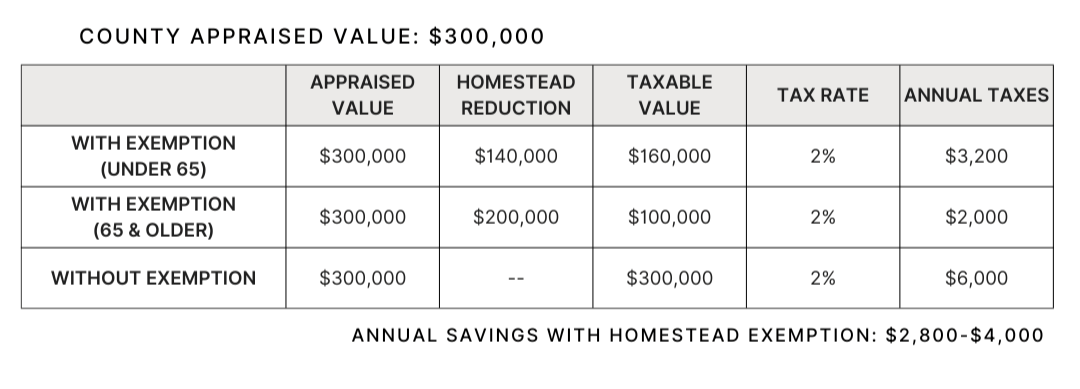 In the table above, you’ll see the comparison:
-
Without the homestead exemption, taxes are calculated on the full assessed value.
-
With the homestead exemption, the taxable value is reduced, resulting in meaningful annual savings.
For many homeowners in the Houston area, this can mean hundreds to even thousands of dollars saved per year, depending on the property value and local tax rates. Over time, those savings compound, especially when you factor in the 10% annual cap on assessed value increases for homesteaded properties.
Why This Matters Long-Term: The Homestead 10% Cap
Filing your homestead exemption does more than reduce your taxable value.
Once approved:
-
Your taxable value increase is capped at 10% per year (even if market value rises higher)
-
You gain strong homestead protections under Texas law
-
If you qualify for over-65 or disability exemptions, school taxes may be frozen
In appreciating markets like Katy, Cypress, and The Woodlands, that 10% appraisal cap protection is extremely valuable.
Common Mistakes to Avoid
❌ Paying a third-party service (filing should be free)
❌ Not updating your ID to match the property address
❌ Assuming your lender files it (they don’t)
❌ Filing in the wrong county
❌ Thinking it applies to rentals/second homes (it’s for your primary residence)
One Simple Step That Pays Off for Years
Filing your homestead exemption is one of the simplest ways to reduce your property taxes in Texas, but it only works if it’s done correctly and on time. A small form can make a meaningful difference in your long-term homeownership costs.
If you have questions about eligibility, deadlines, or how this fits into your overall homeownership strategy, we’re here to help. Smart homeowners don’t leave money on the table and neither should you.
Have questions about your homestead exemption? Let us be your resource for all things real estate.
Connect with us:
📞 Book a consultation call: 832-779-5478
🌐 Visit our website: www.newcombrealtygroup.com
📲 Connect with us: Instagram | Facebook | TikTok | YouTube | LinkedIn
Categories
- All Blogs (95)
- Conroe (4)
- Cypress (15)
- Dallas-Fort Worth (2)
- Hockley (5)
- Home Ownership Information (37)
- Houston (9)
- Katy/Fulshear (10)
- Magnolia (4)
- Market Forecast (12)
- Memorial (2)
- Neighborhood Information (43)
- New Caney (2)
- Pearland (3)
- Relocation Guide (44)
- Retiree Relocation (3)
- Richmond (5)
- Spring (5)
- Sugarland (2)
- The Woodlands (6)
- Tomball (6)
- Waller (2)
Recent Posts











Realtor® Listing Specialist and Team Lead License ID: 634969
+1(832) 779-5478 | kristina.newcomb@exprealty.com